
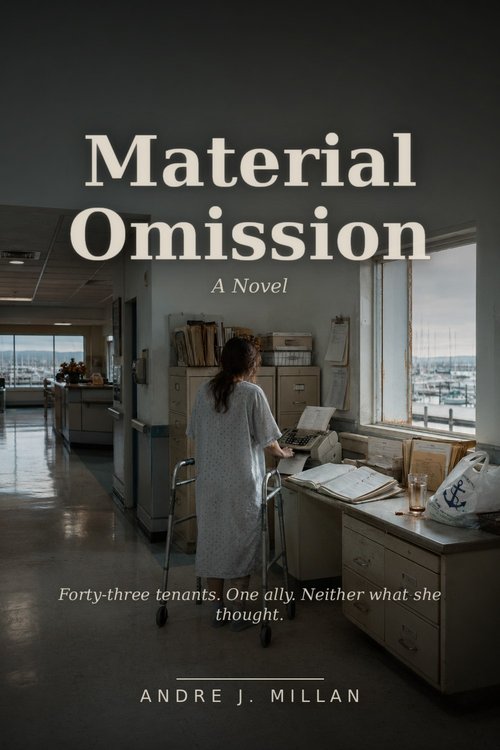
About the Book
Material Omission
A spoiler-free guide for prospective readers.
Is this literary fiction or a thriller?
It lives in the space between the two. The machinery of a thriller is present — a ticking deadline, documents that matter, stakes that reach beyond one room — but the telling is unmistakably literary, built on interiority, close observation, and the slow accretion of detail. Readers who want propulsion will find it, and readers who want prose that rewards attention will find that too.
Is there action?
Not in the conventional sense. The drama here is largely interior and conversational — its tension comes from what a confined narrator notices, weighs, and withholds rather than from physical movement. Much of the book unfolds within a single hospital room, where the smallest gestures carry weight and a deadline presses quietly against everything. It's a tense book, but the suspense is psychological and procedural rather than kinetic.
What themes does it explore?
It moves through questions of knowledge and inaction — the difference between understanding a thing and doing something about it — alongside trust, professional responsibility, accountability, and the cost of the choices we postpone. It's also concerned with confinement, both literal and otherwise, and with how people justify the gap between what they know and what they're willing to face. The novel raises these questions with care and lets them stay genuinely open.
What kind of atmosphere does it have?
Hushed, cold, and meticulously observed. The setting is a wintry marina town and a hospital ward under flat, indifferent light, rendered with an almost forensic attention to small physical detail — the interval of a dripping tap, the smell of overlooked flowers, the precise position of objects on a bedside table. The mood is one of suspended, claustrophobic stillness charged with a low and steady pressure, like weather that refuses to break.
Who would enjoy it?
Readers who love slow-burn, atmospheric fiction where mood and precision matter as much as plot — admirers of literary suspense, character-driven interiority, and prose that treats restraint as a virtue. If you enjoy stories that trust you to sit with ambiguity, that build tension through observation rather than spectacle, and that reward close reading, this one is for you. Readers who prefer fast pacing and frequent action may find it too quiet.