
About the Book
The Quiet Sabotage
A spoiler-free guide for prospective readers.
Is this literary fiction or a thriller?
This is literary fiction. While it carries the slow-burning tension of a mystery, its real interest lies in interiority, perception, and the texture of a single mind under pressure rather than in plot mechanics. Readers expecting a conventional thriller's momentum should know that the suspense here is psychological and atmospheric, built sentence by sentence rather than through twists.
Is there action?
Not in the kinetic sense. The novel unfolds in a confined setting over a short span of time, and its tension comes from stillness, hesitation, and the weight of small physical gestures rather than from chases or confrontations. The drama is internal and observational—what it feels like to sit with something difficult—so readers drawn to quiet, immersive intensity will find more to hold onto than those seeking fast pacing.
What themes does it explore?
It moves through memory and its unreliability, the distance between feeling wronged and being implicated, the things we owe other people and defer, and the stories we tell ourselves to make a choice feel inevitable rather than made. It's interested in attention itself—what we let ourselves see and what we look at instead—and in responsibility as something quieter and more ambiguous than blame. These are explored as open questions the reader sits inside, not as problems the book tidily closes.
What kind of atmosphere does it have?
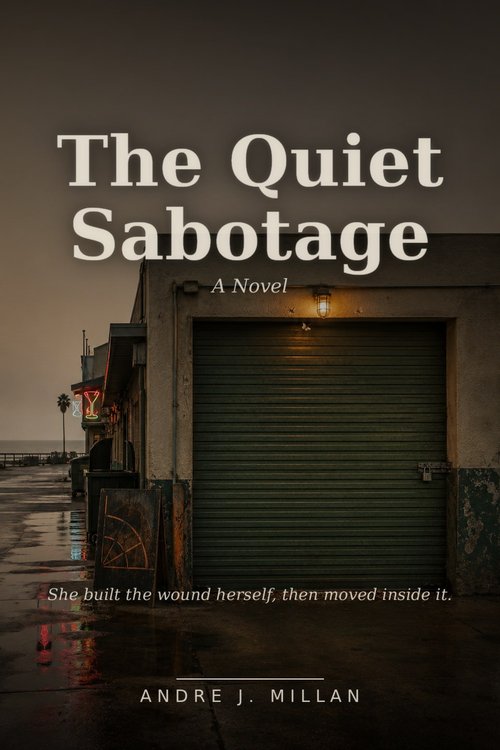
Hushed, hazy, and saturated. Wildfire smoke flattens the light, neon bleeds in the humid air, and a low electrical hum runs under everything—an environment that feels suspended out of time. The prose is precise and sensory, attentive to texture, sound, and the smallest movements, creating a mood that is contemplative and faintly dreamlike, charged with unease that never quite breaks.
Who would enjoy it?
Readers who love immersive, character-driven literary fiction and don't need a plot to move quickly to stay engaged. If you're drawn to slow, atmospheric novels that reward close attention—books where mood, perception, and language do the heavy lifting—this will resonate. Fans of interior, mood-forward writing will feel at home; readers who prefer brisk, event-driven stories may find it too still.